
Hidden Helmets - A Combat Safe Portrayal of a Thematic Soldier
6 August 2026
Helmets in Medieval Reenactment
The difficulty of including lightly armoured soldiers within reenactment medieval combat has been a persistent problem. Most combat rules necessitate a thoroughly protective harness, in line with the most heavily armoured (and therefore elite) soldiers of the middle ages. This has resulted in a lopsided portrayal of battles and a sad lack of variety in the types of soldiers and warrior that might have been found on a medieval battlefield.
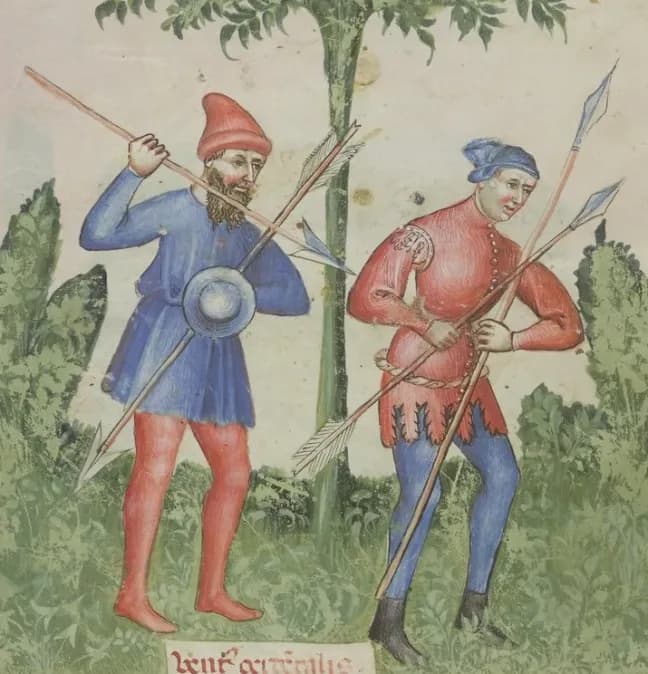
Looking to assuage this imbalance in portrayals, some re-enactors have employed hidden helmets underneath caps or hats to provide the appearance of an unarmoured or lightly armoured soldier (Figure 1 and 2). It is also worth noting that the use of ‘concealed’ helmets was also done historically with iron caps set beneath coifs in the 13th century, and of skull caps worn underneath elobrate hats in the Early Modern Era.


A Helmetless Byzantine Light Infantry
The Byzantine army of the middle period (9th to 12th centuries) deployed a variety of skirmisher and light infantry units with specialised roles. These included the peltastoi and psiloi wielding javelins, slings, axes and small shields as well as the toxotai foot archers. Most of the combat manuals of the 10th and early 11th century indicate that these soldiers only had access to padded armours, including a quilted silk or cotton cap wound with a turban (McGreer 1997).
This same principle of a concealed helmet could be used to make a combat safe toxotai (archer), peltastoi (javelin) or psiloi (light shock infantry) impression. The use of quilted hats and turbans should work to conceal a steel skullcap, while providing the silhoutte of a helmetless soldier. The turban/cap can also be set in such a way as to provide some neck and face protection, and it is recommended that anyone attempting this should include a quilted aventail (or have the quilted cap extend down the neck).
It should also be noted that the concealed helmet must be 2mm thick, regardless of the extra coverage provided by quilted caps or turbans. By using a concealed steel cap underneath a quilted cap and/or turban, it should be possible to present a visually authentic light infantryman or archer of the Middle Byzantine period, while keeping to the ALHF and QLHF combat standards.


Why do it?
Concealed helmets are cheap and easy to acquire pieces of kit that can be used to outfit an authentic light infantry persona that would be capable of participating in group combat events. Combat bows, javelins, a light shield, a spear, or an axe would all work well with a Psiloi/Toxotai impression, and are generally more accessible and lower impact weapons to train than the polearm or sword and shield based combat kits.
This would also provide new re-enactors starting combat with an easier path for steadily building an accurate impression, rather than rushing into a varangian or tagmatic persona with the cost and research required to present these units effectively. As the pieces of kit used by the light infantry form the foundation of a heavy infantry persona, the transition to a more elite soldier can be made naturally, perhaps true to what would have occurred historically as some soldiers acquired more experience and wealth across years of service.
It is also worth noting that this may provide a more inclusive persona. A vivid account from the Bishope Evstathios of Thessaloniki in the 12th century recalled;
"Women made turbans and padded protective garments for themselves in the manner of regular soldiers and took to the walls to shoot and cast stones at the attackers." (From Dawson 2015).
Thus, for women who would prefer not to adopt a male persona, this provides an attestable way to equip themselves for combat.


References
- Liebrenz, B. 2022. Talking Hats: What Documents and Textiles Can Tell Us about Each Other. Journal of Material Cultures in the Muslim World (3) 174-204.
- Thorglisson, U. 2013. Making a Concealed Helmet. In the Shield Wall Blog. Retrieved from https://intheshieldwall.wordpress.com/2023/03/11/making-a-concealed-helmet/
- Dawson, T. McBride, A. (artwork). 2012 Byzantine Infantryman: Eastern Roman Empire c.900-1204: Osprey.
- Dawson, T. 2015. By the Emperor's Hand: Military Dress and Court Regalia in the Later Romano-Byzantine Empire.
- McGreer, E. 1997. Sowing the dragon's teeth: Byzantine warfare in the tenth century. Washington, D.C.: Dumbarton Oaks Research Library and Collection.
- Skoll Reenactment Group 2022. Making Caphelms. Retrieved from https://sagy.vikingove.cz/en/making-of-caphelmets/