
Byzantine Hiking
9 August 2026
Manning the Frontier
Patrolling and skirmishing was a necessity for the soldiers of the Byzantine Army, especially for troops posted to the frontier. The deployment of small infantry patrols had been a standard information gathering and proactive anti-raiding tactic from earlier Roman period, as the Limitani sought to maintain the Empire's vast frontier. The basic principles of patrolling were maintained and adapted into the Byzantine era, and the Empire's field armies remained reliant on small squads of infantry and cavalry to gather information, and to maintain an Imperial presence in remote regions well into the Middle Ages.
The principles of skirmishing, scouting and marching were detailed in the numerous military manuals of the Middle Byzantine Period, which provide a level of insight into military doctrine that is rare for medieval warfare. In particular, the Peri Paradromēs, a 10th century manual on skirmishing, provides Reenactors with a staggering level of detail and offers us a guidebook we can utilise to recreate the movements of small frontier units. The Peri Paradromēs was composed at the closure of the great Arab raids into Anatolia, and is careful to document a variety of manoeuvres, including laying ambushes, raiding, night operations, and the seizure of prisoners for interrogation, as well as the more standard occupation and maintenance of border posts.
Recreating Byzantine Scouts
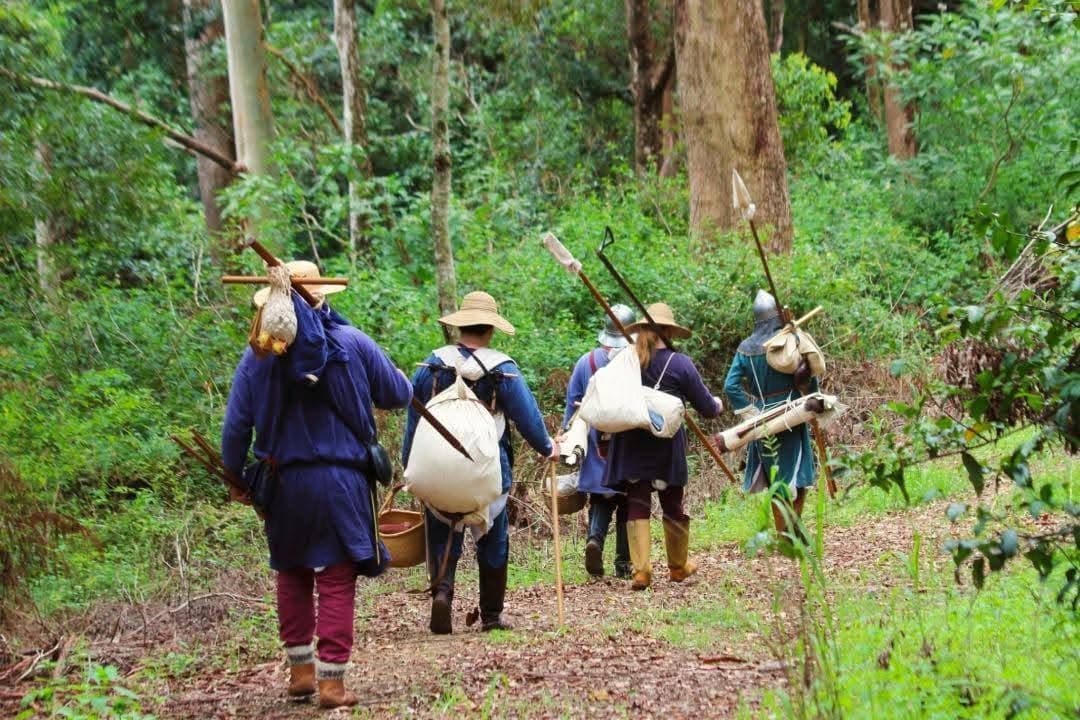
Due to its contained, self-sufficient nature, skirmishing and scouting offers reenactors a powerful exercise in recreating an element of Byzantine warfare. It is, by its nature, a more achievable exercise than the recreation of battles or of vast encampment settings and forces us to put period accurate tools to the test in their intended environment of usage. Rusland sought to recreate one of these small frontier patrols with a November hike into along the forested ridgelines of Mount Glorious, in the D’Aguilar National Park northwest of Brisbane. Our unit was comprised of five soldiers with individual roles, as advised in the Peri Paradromēs, and the earlier Strategikon of Maurice, which also offers advice for the armament and provisioning of scouts.
-400x300.jpg)
As recommended in the field manuals, we left much of our equipment at home. Marching with the main army on campaign, a conturvernium, or small field unit of about eight men, would have been provided with pack mules and could rely on periodic resupply from the vast wagon trains that accompanied the army - a fact most reenactors use over liberally when we load our cars with gear, tents and furniture for modern events. As an isolated patrol travelling discretely in the hills, we instead needed to carry all of our own equipment without the aid of pack animals. This forced us to carefully consider the advice of the field manuals, and to distribute gear and weaponry amongst our small unit.

An immediate issue when distributing our equipment was shelter. While a conturvernium would have shared a large pavilion tent on campaign, this was an excessive amount of canvas to haul for our patrol. Turning to the Strategikon, the author recommends that soldiers only take "small tents or two heavy cloaks, the one for covering if needed and the other as a tent or shelter." (Strategikon 5:4). Small ridge shelters can be seen in the illuminations of the Vienna Genesis and the Ambrosian Iliad which both offer an image of how these basic shelters described in Strategikon may have looked when pitched in the field. Rudimentary shelters of lashed grass or palm frond can also be seen in illuminations from the Middle Byzantine period, suggesting that soldiers may have built their own shelters on occasion.

Roman reenactors have extrapolated on the Strategikon's suggestions and have found ways to pitch canvas and woolen blanket ridge tents using their spears as the central pole for the shelter. Thus, some members of our patrol decided to sew small sheets of canvas, approximately 2x2m, to attempt these basic field shelters. However, as we were hiking to a remote cabin, the majority of our patrol opted not to carry canvas and instead brought woollen cloaks, blankets and hides for rudimentary swags. It is a safe assumption that medieval patrols similarly sought shelter in villages, shepherds’ huts, ruins, and in natural shelters where possible. It is also probable that the network of border fortresses along both the Danube and the eastern frontier probably maintained small watch posts or semi-permanent campsites along frequently patrolled routes.
Very little is known about medieval travelling packs, and so our patrol opted for a variety of methods to stow and carry our gear. These included some 'furca' type systems using cross-shaped pole to hang gear over the shoulder, similar to bindles. These were inspired by the depictions of furca carried by Roman legionaries on Trajan’s columns, but bindle bags are also seen in Byzantine Illuminations of the 12th century. Baskets, linen sacks and saddle bags, leather satchels, bedrolls, and rudimentary frame backpacks were all used to varying degrees of success.


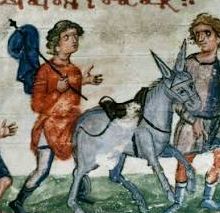
Patrols needed to be largely self-sufficient, carrying ample supplies and equipment for long marches into rugged territory. Therefore, we opted to carry both fresh produce; with meats, soft cheeses, fruits and vegetables, as well as preserved rations including dried meat and fruit, buccelatum (Roman hardtack) and honeyed vinegar (posca). Our toolkits included knives, several handaxes, tinderboxes with flints, steels, charcloth, flutes and jaw harps, costrels for water, and ceramic cooking pots. We also carried several spears, both as the primary weapon of the infantry, and for constructing ridge shelters, as well as javelins, slings, one large waraxe, and one sabre as alternative weaponry that may have been carried by fast moving skirmishers. Several members of the patrol wore steel helmets, though we largely stuck to our lightest linen and wool clothing due to the heat. In the future, bows and shields should be distributed within the patrol, as these specified as useful skirmishing weapons in the Strategikon.
Rusland's Patrol
Our hike was a short 4km march up a fairly sustained ridgeline, following an old forestry road through temperate rainforest and open woodland. We felt that this environment provided some useful proxies with the old growth woodlands found in the Balkan Mountains. The November Spring weather was humid and punishing, and rolling showers lingered over Mount Glorious for most of our hike.


We arrived at the cabin by the early afternoon and proceeded to pitch a basic camp. The campsite was at the edge of an exposed ridgeline and provided sweeping views into the coastal lowlands of Samford Valley - a prime location for observing the movements of a distant army. While we had intended to stay for the night, incoming tropical storms forced our unit to decamp and head down the mountain as the ridgeline was heavily exposed even with the shelter offered by the semi-enclosed cabin. In all, it was a successful day out that put our gear through its paces. All members of the patrol learned lessons about the functions and capability of their equipment, and it was a thoroughly immersive day in a wonderful piece of National Park.


