
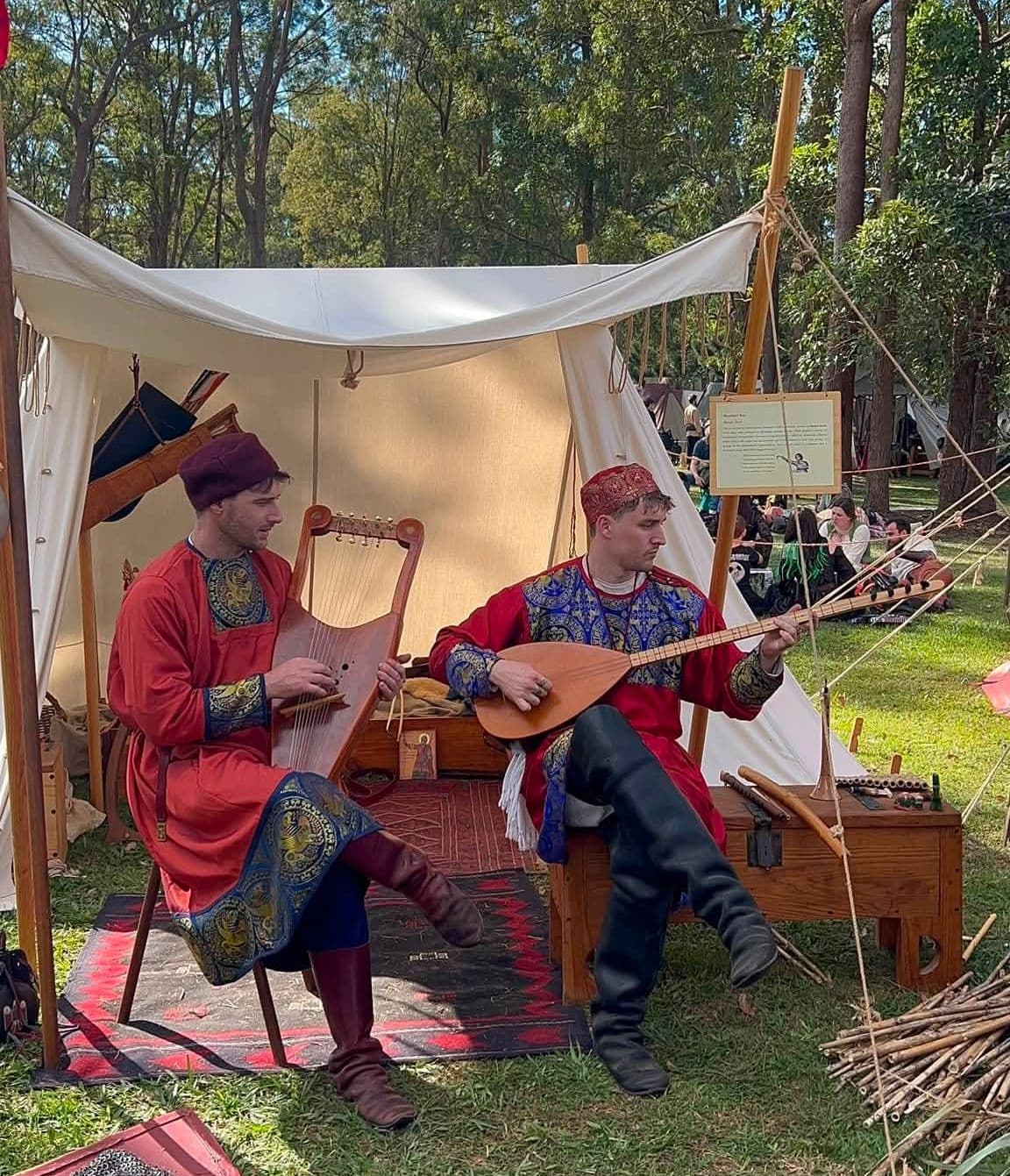
Byzantine Music in a Reenactment Setting
10 August 2026
Music is a fundamental piece of cultural expression. Yet, it is one of the more difficult elements of the past for reenactors to reliably reconstruct. This is especially true for recreations of proto-historic societies, such as Norse or Steppe cultures, in which we can draw only from a fragmented archaeological record, and from allusions to a musical tradition given by outsiders from neighbouring literate cultures– you may reconstruct an instrument from an artefact, but not the songs that it was used to play.
For Byzantine reenactors, we are fortunate to have both art and written descriptions of music to draw on, though there are very few physical examples of musical artefacts that have survived from the Middle Byzantine Period. Brass bells, jaw harps, and fragments of instruments such as tuning pegs are the only artefacts I am aware of that have survived from this era. However, there are artefacts from neighbouring cultures we may tuen to, including a collection of gudoks that have been excavated in Novgorod. There are also earlier Roman period and near Eastern instruments that have been preserved, and offer us insight into the construction methods probably used for related Byzantine instruments.

Figure 1: A Byzantine lyra compared to artefacts from Novgorod (ivory casket 900 – 1100 AD Museo Nazionale, Florence)
Where artefactual evidence is sparse, it is possible to draw a direct connection between many of the instruments depicted in medieval artwork with contemporary folk counterparts from the eastern Mediterranean. This allows us to talk with some confidence around continued ‘Byzantine’ and ‘Slavic’ traditions that have been preserved in folk music, with the caveat that most contemporary instruments have been modernised to some degree. We must also be extremely cautious when using folk music as a source, as no tradition is completely static, and many Balkan and eastern Mediterranean traditions have evolved in the post-medieval period, especially under the influence of the Ottoman Empire.

Figure 2: A Byzantine tambouras and a Greek bouzouki (from Museum of Greek Folk Musical Instruments – Ethnomusicology Centre)
There is also a wealth of primary literature from the Byzantine period on music theory which can inform reenactors on modes, scales and tunings for our instruments, as well as on lyrics to accompany our music. Manuscripts from the period sometimes include basic musical notation called “ekphonetic notation”, though this is almost exclusively used for church music and hymns.

Figure 3: An example of a post-Byzantine manuscript with musical notation
Rusland’s Instruments
In a treatise on alchemy from the 7th century, we find two paragraphs concerning Byzantine music as it was perceived by the author at the opening of the Medieval period. This author refers to the modes of music as “echos”, and categorises all instruments as falling into the following categories; kitharika (stringed instruments), aulitika (wind instruments, including brass and woodwind), and nausta (percussion). Rusland has a collection of instruments from all of these categories.
For kitharika, our main instrument is a tambouras, a long-necked lute that was adapted from Persian tanburs and replaced the earlier Greco-roman pandura lutes. They have fallen out of favour in modern Greek music, as bouzoukis and laoutos have largely supplanted them.

Figure 4: A long neck lute in the late Byzantine period, alongside an early Byzantine panduri lute (Left: Romance of Alexander. 14th c. Ven._Inst._Gr._5__fol._91. Right: Great Palace Mosaic Museum, Istanbul.)
We also have a Roman style kithara, based on the frescoes from Pompei, but broadly similar to the diverse range of lyre harps seen across Byzantine artwork. In general, stringed instruments are not standardised and come in a variety of shapes and types across the Byzantine period.

Figure 5: Two harpists and a lutist (Paris._Gr._135__fol._150v 14th. c.)
We have two lyras (also called kemence), one of the Constantinopolitan type, and one of the Pontic style. These are a bowed instrument, similar to modern violins, and were probably the chief instrument of the Byzantine period, as attested by an Arabic writer Ibn Khurradadhbih in the 9th century. They were adopted from Steppe cultures, and are closely related to the rebec, which was a staple of Western medieval music. Variants of the lyra are still played across Greece today, especially on Crete.
We have a range of aulitika, from simple reed pipes called mantura, through to oboe-like instruments such as the duduk. Our zournas and trumpet are raucus instriments reserved for parade. A koncovka, a central European fipple flute, is a fantastic solo instrument and can be carried by soldiers when we hike into the mountains for patrol events. Similarly, jaw harps are also a popular campfire instrument within Rusland.

Figure 6: A soldier carves a reed flute (c1370-1375 Ub. Leipzig, Cod. Gr. 35)
Finally, our nausta section includes double walled goat skin davul drums with distinctive apricot wood beater, smaller frame drums, kettle drums and bronze cymbals. These work to accompany all forms of music, and as parade instruments.

Figure 7: An orchestra in the Skylitzes Manuscript (National Library, Madrid, codex vitr. 26-2, pg. 173. folio 78r.)
How We Present ‘Byzantine’ Music
While we lack notation for medieval music (outside of church traditions) the lyrics to many popular songs have been preserved in primary texts, generally called katalogia (secular music). The katalogia include nursery songs, love songs, songs of mockery, work melodies, laments, songs for singing around the table, theatrical music, matrimonial songs and “epasmata” or incantations, epic songs and magical invocations. The katalogia may not preserve exact notation, but they give us insight into the breadth of musical expression that circulated throughout Byzantine life.
We are also indebted to musical ethnographers, especially Domna Samiou, for examples of 'Byzantine' tradition in Greek folk music. One example is Samiou’s recording of the folk song “Now the Birds” from northern Macedonia, which is a surviving example of the Byzantine genre of “chelidonismata”, meaning “songs for the coming of the swallows”. We cannot be sure that Samiou’s recordings are the same as the medieval melodies, but it is probable that these isolated folk traditions preserved a range of Byzantine motifs and themes.
For Rusland's events, we have created out own camp songs using a mixture of Greek/Oriental folk melodies and the lyrics and themes of the katalogia. In camp we perform marching chants, drinking songs, love songs and laments, and epic poems from the tales of Digenis Akritas (a popular 12th century ballad) that give a sense of the musical soundscape of a military camp. While this is not truly authentic Byzantine music, we hope that it translates a sense and feel of Byzantine songs, and makes medieval oriental music and instruments accessible to fellow reenactors and members of the public.

Figure 8: A drummer coordinates the recruits as they are drilled

Figure 9: A large kettle drum played in the mess shelter

Figure 10: A performance on the tambouras
Bibliography
Botonakis, A. Ozkilic, M. 2022. The Sounds of Byzantium. KOÇ ÜNİVERSİTESİ STAVROS NIARCHOS VAKFI.
Despic, D. Jovanovic, J. Danka, L-M. 2012. Musical Practices in the Balkans - Ethnomusicological Perspectives. Belgrade Institute of Musicology. Serbian Academy of Sciences and Arts
Kalaitzidis, K. 2016. Post-Byzantine Music Manuscripts as a Source for Oriental Secular Music (15th to Early 19th Century). Oriental Institute of Istanbul.
Liveri, A. 2021. "Dance Music" in Byzantium and the Balkans. Series Musicologica Balcanica, 1.2.
Zeeuw, D, H. 2022. Tanbur Long-Necked Lutes along the Silk Road and Beyond. Archeopress.